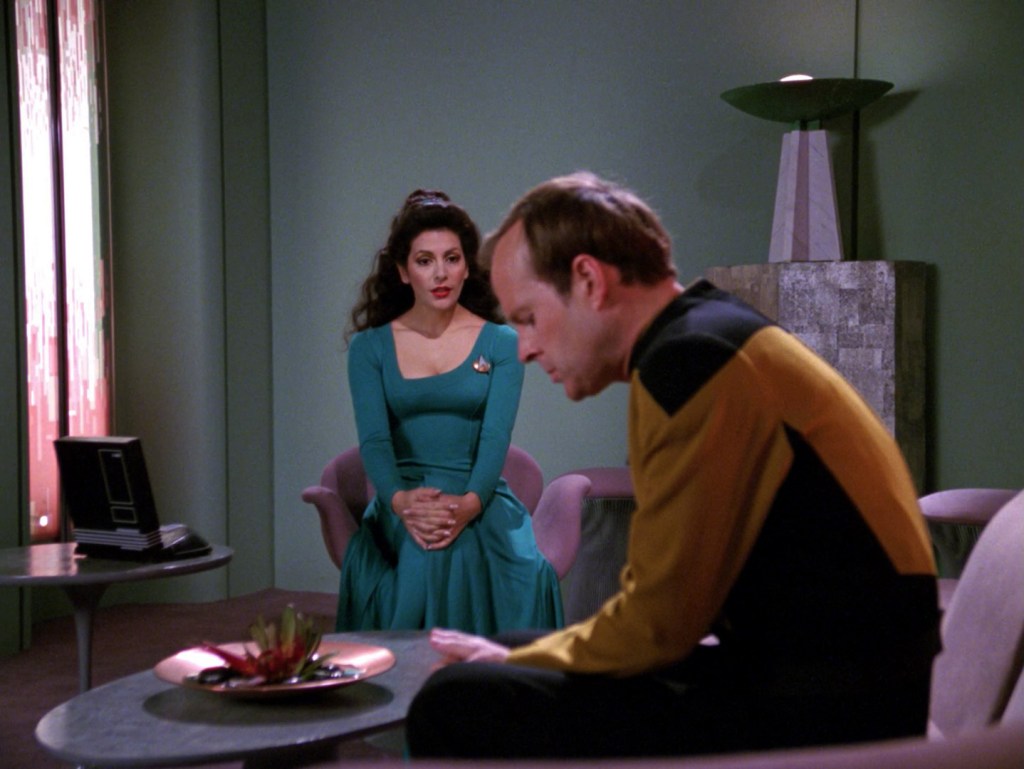
Star Trek: The Next Generation Season 3; Episode 21 “Hollow Pursuits”
Geordi ENTERS… the room is deserted now except for Barclay who is off to one side looking over the disassembled antigrav unit. It’s open, the guts exposed as he traces circuits with a sensor. Geordi frowns to himself as he looks over to Barclay, whose back is to him.
GEORDI
(muttering, to himself)
My best friend.
Geordi moves up behind him, and pats him on the back.
GEORDI
Hey, Reg…
And Barclay nearly jumps out of his shoes at the unexpected physical contact.
GEORDI
Uh, how’s it going?
BARCLAY
Oh, it’s… I still haven’t traced the problem, Commander…
GEORDI
(smile, “warm”)
That’s okay. No rush. Take your time.
Barclay notes this new tone of voice from Geordi… glances at him suspiciously… a beat. Doesn’t trust the moment… rushes to fill the gap…
BARCLAY
I’ve… I’ve been planning to run diagnostics on the graviton invertor circuits…
GEORDI
Smart plan… well, I’d say we’re in good hands here…
BARCLAY
(still suspicious)
I’ll get a preliminary report to you…
GEORDI
…whenever.
BARCLAY
(beat)
Before the end of the day.
GEORDI
Fine. And say, Reg, how about sitting in on the mission briefing with my senior officers in the morning…
BARCLAY
The briefing? Me?
GEORDI
I’d just like your input…
BARCLAY
On what? I mean, should I prepare something..
GEORDI
No… no… just be there. Eight hundred hours.
BARCLAY
I’ll be on time, sir.
GEORDI
Good.
This is a great scene that reveals a lot about Geordi and Barclay’s characters. It illustrate very clearly Geordi’s relationship with Barclay and Barclay’s view of his crewmates.
As Geordi approaches Barclay for the first time after Picard sets him on this task, he lets one last lament out. It’s important to always acknowledge your feelings, but as a leader, it is part of your job to do what’s best for your team and the individuals who comprise it.
Barclay’s initial reaction to Geordi’s tap on the shoulder could convey a couple of different things, either… 1) He was so focused on his work that he was oblivious to anything going around him, or 2) It’s been a really long time since anyone actually approached him.
Either should be a red flag. Someone who is hyper-focused on a task can seem like a good thing and I’m sure, at times, it can be. But it can also be very detrimental. Being so focused, you can easily lose sight of the goal. Perfectionism can cause loss of productivity, faster burnout, creative blocks, etc.
Geordi attempts to put Barclay at ease and reassure he’s just checking in. Barclay is not reassured and Geordi realizing this, changes tactics. He invites Barclay to a meeting with the senior engineers.
This is a great tactic when someone is lacking in confidence and social skills. Obviously, it conveys a certain amount of trust, but more so, it pulls the employee out of their normal routine and exposes them to senior leaders in the department. When someone has high anxiety and low self-confidence, it can help for them to just have a seat at the table. Take Weasley as an example. Picard has him sitting in Senior staff meetings all over the ship. Allowing him to learn from a variety of people and become comfortable with different cliques. Barclay tends to isolate himself, so joining a high-functioning group and seeing how they interact can help him be comfortable and acclimated to that environment.
The meeting doesn’t go according to plan. Barclay arrives slightly late and when Geordi gives him a chance to update everyone on his assignment, he wasn’t emotionally prepared to handle the interaction. Being late is not a big deal, but it does need to be addressed in a one-on-one situation. Why was an introvert late, was it just anxiety or is there something else happening. In Barclay’s case, he was getting caught up in the holodeck (or in recreational activities), but why? Why is he getting caught up in other activities. Always get to the root cause, don’t stop at the symptoms. Keep asking why.
Drawing out an introvert employee involves a nuanced and delicate approach that recognizes and respects their unique communication preferences and work style. Introverts often thrive in environments that allow for quiet reflection and thoughtful analysis, so creating opportunities for one-on-one interactions or small group discussions can be instrumental. Providing a comfortable and low-pressure space for them to express their ideas ensures that their valuable contributions are not overshadowed by more extroverted colleagues.
 Home
Home 
Leave a comment