
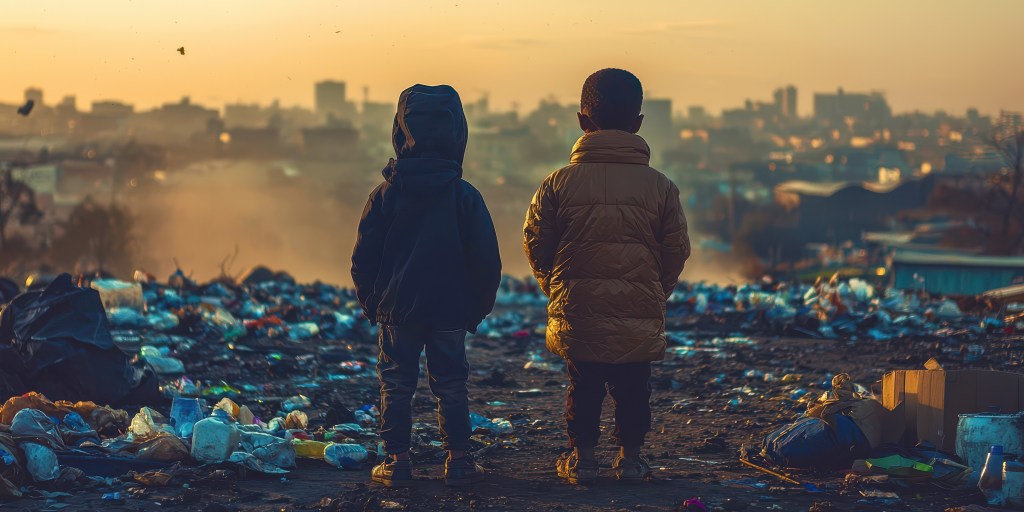
What Captain Planet and the recycling boom didn’t teach me about environmental power.
The bad guys had factories, oil barrels, logging machines, smokestacks, and toxic waste. We had blue bins. As a kid, that felt like a fair fight.
I am glad I grew up with environmental messages loud enough to remember. I enjoyed the cartoons, school activities, Earth Day specials, recycling drives, and PSAs telling us the planet mattered. A lot of that messaging worked. It got kids like me to pay attention.
But looking back, I see how off the equation was. The destruction we were shown was huge, industrial, profitable, and political. The solutions we were handed were personal, moral, and usually local. The people wrecking the planet had machinery, permits, supply chains, packaging decisions, and lots of money. We had chores.
Captain Planet was not wrong. That is the frustrating part. The message worked.
The show aired from 1990 to 1996, right as recycling was becoming highly visible in American homes, schools, cities, and public campaigns. The timing almost feels too neat now: five Planeteers, each with a magic ring, summoned by Gaia to fight pollution, deforestation, poaching, toxic waste, and whatever else the eco-villains were doing that week. It was environmental education with a theme song, a superhero, and a moral clarity that made sense to a kid. Pollution was bad. Greed was bad. Dumping sludge into a river was bad. Even as a kid, I got it. [1]
The misleading part, of course, was the slogan: The Power Is Yours.
I loved that. I still kind of love that. I want kids to believe they can help. I want caring to feel active instead of helpless. But the older I get, the more I question how much power we were actually being handed. The slogan sounded like empowerment, but the message I absorbed was smaller and heavier: buy better, toss better, choose better, and the factories will somehow follow.
Maybe this sticks with me now because a lot of my work has been taking messy information and figuring out what people will actually remember. I’ve learned how useful a clear message can be. I’ve also learned that simple is not the same as true, and a message can be memorable while still leaving out the most important parts.
And the environmental message I grew up with was very memorable.
Captain Planet also did not come out of nowhere. Barbara Pyle, one of the show’s creators and executive producers, has said many of the ideas came from The Global 2000 Report to the President, a Carter-era report warning about population pressure, resource depletion, pollution, food stress, species loss, and the long-term consequences of ignoring environmental trends. In one interview, Pyle said Ted Turner handed her the report and treated it like her job description. [2]
That detail makes the show more interesting to me, not less. The adults making it were looking at real warnings about policy, resources, energy, food, forests, water, and global systems. Then those warnings had to become Saturday morning television. The source material was about systems. The show gave us villains. The broader culture gave us blue bins.
Before Captain Planet gave us eco-villains, America had a floating trash monster. In 1987, the Mobro 4000 left New York carrying more than 3,000 tons of garbage and spent months going from port to port being rejected. No one wanted the trash. The barge became a perfect media image: a rotting, unwanted pile of garbage drifting around because no one wanted responsibility for it. It was disgusting, simple, and impossible to ignore. [3]
A floating pile of trash did what a hundred posters could not. It gave the waste problem a body. Suddenly, the crisis was not abstract. It was a barge. It was out there. It smelled bad. It had nowhere to go. Once the problem looked that obvious, the answer started to look obvious too: we needed to recycle.
For kids, the story got simpler from there. Trash was piling up. Landfills were scary. The adults had made a mess. Here was the thing we could do: reduce, reuse, recycle. By the early 1990s, that message really was everywhere. EPA data says recycling and composting did not exceed 15 percent of municipal solid waste generation until 1990, then grew significantly over the next 15 years. The blue-bin feeling was not just nostalgia. We really were growing up during the recycling boom. [4]
By Earth Day 1990, environmental concern had gone mainstream. Not just locally. Globally. It was on television with celebrities, fictional characters, and the kind of earnest, slightly chaotic sincerity only 1990 could produce. The Earth Day Special aired on ABC on April 22, 1990, with Bette Midler as Mother Earth and appearances from Danny DeVito, Rhea Perlman, Bugs Bunny, the Muppets, Doc Brown, E.T., and what feels like half of television at the time. It was two hours of pop culture saying: the planet is sick, and everyone needs to care. [5]
Captain Planet premiered in September that year.
Disney’s Recycle Rex followed in 1993, released by Disney Educational Productions in cooperation with the California Department of Conservation. The short focused on reducing, reusing, and recycling. It made the problem friendly and classroom-ready. There was a real waste problem, but the solution came with cute dinosaur kids and an action plan that could fit on a worksheet. [6]
That was the mood. Green bubble letters. Classroom posters with smiling Earths. Sad Earths with thermometers in their mouths. Celebrity appeals. Children’s choirs. Recycling symbols. “Do your part.” It was hopeful, and I do not want to flatten that hope into a joke. It really did feel like the culture was turning toward the problem. It felt like everyone had agreed the planet mattered.
But this is where I get twitchy now. A good message can make participation feel like progress before anything structural has changed. The blue bin did that for me. It said someone had thought this through. Trash went one place. Recycling went another. The good stuff got saved. The responsible path had been built, and my job was to follow it.
The “do your part” message was older than us, though. Long before Captain Planet told kids the power was ours, Keep America Beautiful was teaching Americans to think about pollution through individual behavior. Keep America Beautiful traces its origins to 1953, when representatives from civic groups, conservation groups, government agencies, and industry met to address roadside litter. Its own history notes involvement from representatives of the packaging and beverage industries, and the American Beverage Association says Coca-Cola and PepsiCo were among the organization’s founding members. [7]
And it worked.
Keep America Beautiful’s famous 1971 Crying Indian PSA became one of the most recognizable environmental ads in American culture. Its message was clean and devastatingly simple: “People Start Pollution. People can stop it.” The ad made pollution feel personal. Not industrial. Not political. Personal. It asked viewers to feel responsible for the mess they saw, and emotionally, it worked. But the framing mattered. Pollution became something people did when they littered, not something companies designed into disposable systems. [8]
Woodsy Owl did something similar for kids, with a softer face and a catchier line. The U.S. Department of Agriculture debuted Woodsy Owl in 1971, and his motto was “Give a hoot; don’t pollute!” Again, I am not here to argue in favor of pollution. But listen to the direction of the message: don’t litter, don’t be careless, don’t make a mess, lend a hand, clean it up. The public was being trained to look for environmental responsibility at the point of disposal. [9]
By the time my generation got Captain Planet, that script already had decades of practice.
The 1990s made it louder, brighter, and much weirder. That decade loved turning pollution into a villain. FernGully gave us Hexxus, a seductive pollution monster voiced by Tim Curry, oozing out of machinery and feeding on destruction. Toxic Crusaders turned toxic waste into a gross-out superhero brand for kids. G.I. Joe got Eco-Warriors. There were slime colors, gas masks, mutant villains, and toy lines built around environmental collapse. Once you notice the eco-villain boom, it is hard to unsee. [10]
A villain gives the audience somewhere to put the problem. That is useful. It is also limiting, because a villain can fit on a lunchbox and a supply chain cannot.
Captain Planet’s villains were not subtle. Their names sounded like someone lost a bet in a writers’ room: Hoggish Greedly, Looten Plunder, Sly Sludge. They were greedy because greed was their whole personality. They polluted because they were bad. They made environmental destruction visible in a way children could process.
Real environmental harm is usually less theatrical. It does not always cackle over a barrel. Most of the time, it looks boring: a quarterly target, a packaging spec, a cheaper material, a jobs argument, a “consumer choice” talking point. It looks like a company designing disposable packaging and then asking you to please dispose of it responsibly.
That is the part the cartoons did not give me. I learned what pollution looked like. I did not learn how much paperwork, lobbying, branding, and legal cover can sit behind it.
The arrows helped sell the story too. The chasing arrows might be the first environmental logo I ever understood. As a kid, I saw them and knew what the story was supposed to be: this goes in the good bin. The symbol looked official. It looked circular. It looked like proof that the system had somewhere for this thing to go.
But the plastic resin identification code was not a promise that an item was recyclable. ASTM says the system was developed to identify resin content, not product recyclability, and that replacing the chasing-arrows graphic with a solid triangle was meant to refocus the code on resin identification because the arrows were so strongly associated with recycling. [11]
That little detail is almost too perfect. A whole generation of kids grew up learning to look for the arrows. To me, the arrows meant the object had a future. I did not know they might only mean, “this is what kind of plastic this is.”
Meanwhile, corporations learned to speak fluent recycling. In 1990, McDonald’s announced it would work with Environmental Defense Fund to phase out its polystyrene clamshell food containers, a major corporate-environmental partnership for the time. EDF later said the partnership helped eliminate more than 300 million pounds of packaging, recycle 1 million tons of corrugated boxes, and reduce restaurant waste by 30 percent over the following decade. [12]
The McDonald’s story is where the easy version of my argument gets too easy. Some changes were real. Some pressure worked. Some packaging improved. The clamshell became something people could recognize, complain about, mail back, and eventually watch disappear. That matters.
It also shows how much easier it is to fight the thing you can see.
A blue bin is visible. A foam clamshell is visible. A crying man on the side of the road is visible. Woodsy Owl is visible. Hoggish Greedly is visible. The chasing arrows are visible. Those images stick because they give the problem a shape.
The harder part is everything behind the shape: the material choice, the packaging meeting, the cost calculation, the lobbying, the regulation, the ad campaign, the decision to make a disposable thing and then teach the public how to feel responsible for disposing of it correctly.
That is why The Lorax still feels like the better childhood lesson to me. It is simple, but it does not start with a kid dropping trash on the ground. It starts with someone cutting down trees to sell something. It shows the warning signs being ignored. It shows a landscape changing because profit kept winning the argument. [13]
The Lorax still gives the kid a seed at the end. It still gives hope. But the hope lands differently because the story has already shown where the damage came from.
Bottle bills are another example of a better-aimed lesson. Oregon passed the nation’s first deposit-return system in 1971 to prevent litter caused by single-use beverage containers. The idea was not simply “people should care more.” It changed the system around the behavior. A bottle or can had value. Return it, and you got the deposit back. The Oregon Encyclopedia says beverage containers went from 40 percent of roadside litter before the law to 10.8 percent in 1973 and 6 percent in 1979. [14]
That is what “the power is yours” looks like when adults actually build power into the system. It is not just moral encouragement. It is a setup that makes the better choice easier, gives the container value, and does not leave the whole burden with the person holding the empty bottle.
This is where I keep landing: recycling is not the lie. Scale is.
Recycling can work better for some materials than others. The EPA’s municipal-waste data shows paper and paperboard recycling reaching 68 percent in 2018, while plastics were at 9 percent in the same table. EPA’s plastics-specific page says landfills received 27 million tons of plastic in 2018. That is not a tiny mismatch between childhood expectation and adult reality. That is a canyon. [15]
The plastic story gets even uglier when you bring in later investigations. PBS Frontline and NPR’s Plastic Wars reported on industry strategy and doubts around plastic recycling, including the role of resin codes and the promotion of recycling as a response to pressure from states and environmentalists. Recent reporting has also focused on allegations that plastic producers promoted recycling despite knowing the technical and economic limits. The point is not that no plastic can ever be recycled. The point is that the public story was much cleaner than the system. [16]
This is where Dinosaurs comes in, weirdly enough. The finale, “Changing Nature,” is famous for being shockingly dark for a family sitcom. The fictional WESAYSO corporation causes environmental damage, attempts increasingly disastrous fixes, and the episode ends with ecological collapse instead of a magical reset. It is the anti-Captain Planet ending. No one shows up at the last second to combine powers. The corporate decision-making chain keeps going until the consequences are irreversible. [17]
I am not saying children’s environmental media should have ended every episode with despair. That would have been terrible television and even worse education. Kids need hope. Adults need hope. I still need hope. But there is a difference between hope and reassurance. Hope gives you somewhere to go. Reassurance tells you someone else already handled it.
The blue bin reassured me.
A better message would have taught me to follow the waste upstream. Who made this disposable? Who profits from it? Who decided this material was acceptable? Who lobbied against better rules? Who benefits when responsibility starts with the consumer instead of the producer? Who gets to turn cleanup into branding while continuing to produce the mess?
That kind of message would have helped me more. It does not tell kids to stop recycling. It tells them recycling is episode one.
If I were pitching a Captain Planet reboot now, I would still give kids the rings. I would still give them powers. I would still give them hope, because the original show was right about that part. Kids should feel like they are part of the world they live in, and they should know the planet is worth protecting.
But I would give them better questions.
The new Planeteers would not just fight a guy dumping sludge into a river. They would follow the sludge upstream. They would find the permit, the loophole, the lobbyist, the trade group, the campaign donation, the greenwashed ad, and the packaging decision made five years earlier in a boardroom. They would still recycle. Of course they would recycle.
But recycling would be the personal habit, not the solution.
I was a kid watching cartoon villains destroy the planet with factories, oil barrels, logging machines, and toxic waste. Then the screen looked back at me and told me to recycle. And I did. A lot of us did. That was never going to solve the problem.
Power is not a ring someone hands you. It is built, protected, bought, hidden, organized, challenged, regulated, and fought over.
Maybe that is what the next generation of Planeteers should demonstrate.
Source notes:
[1] Captain Planet Foundation — Captain Planet & the Planeteers Legacy
Use for: Captain Planet and the Planeteers airing from 1990–1996, the show’s environmental education purpose, Ted Turner / Barbara Pyle connection, and youth “problem solvers for the planet” framing.
[2] The Guardian / Grist / The Global 2000 Report
Use for: Barbara Pyle saying The Global 2000 Report to the President shaped the show; Ted Turner treating the report like her “job description”; the report’s warnings about population pressure, resources, pollution, food stress, species loss, and environmental deterioration.
[3] Newsday — Mobro 4000 garbage barge retrospective
Use for: the 1987 Mobro 4000 garbage barge leaving Long Island/New York with more than 3,100 tons of trash and becoming a vivid symbol of the waste crisis.
[4] EPA — National Overview: Facts and Figures on Materials, Wastes and Recycling
Use for: recycling and composting not exceeding 15% of municipal solid waste generation until 1990, then increasing over the next 15 years; broader recycling-rate context.
[5] The Earth Day Special / Muppet Wiki / IMDb-style pop culture references
Use for: The Earth Day Special airing on ABC on April 22, 1990; Bette Midler as Mother Earth; celebrity and character appearances including Danny DeVito, Rhea Perlman, Bugs Bunny, the Muppets, and E.T.
[6] Disney Wiki — Recycle Rex
Use for: Recycle Rex being a 1993 Disney Educational Productions short made with the California Department of Conservation and focused on reducing, reusing, and recycling.
[7] Keep America Beautiful / American Beverage Association
Use for: Keep America Beautiful forming in 1953 around litter prevention; beverage and packaging industry involvement; Coca-Cola and PepsiCo among founding members according to the American Beverage Association.
[8] Keep America Beautiful / AP / Orion Magazine — “Crying Indian” PSA
Use for: the 1971 “Crying Indian” anti-pollution PSA, its “People Start Pollution. People can stop it” message, its pop culture impact, and later criticism/retirement by the National Congress of American Indians.
[9] USDA / National Archives — Woodsy Owl
Use for: Woodsy Owl debuting in 1971 and the “Give a hoot; don’t pollute!” slogan.
[10] Atlas Obscura — 1990s eco-villains
Use for: the broader 1990s trend of turning pollution into cartoon villains, including Captain Planet, FernGully, Toxic Crusaders, and other eco-villain examples.
[11] ASTM — Resin Identification Code / chasing arrows
Use for: resin identification codes identifying plastic resin type rather than recyclability, and ASTM changing the chasing-arrows graphic to a solid triangle to reduce confusion.
[12] Environmental Defense Fund — McDonald’s packaging partnership
Use for: McDonald’s/EDF partnership, phaseout of polystyrene clamshells, 300 million pounds of packaging eliminated, 1 million tons of corrugated boxes recycled, and 30% restaurant-waste reduction over the following decade.
[13] The Lorax sources
Use for: The Lorax as an environmental fable about extraction, profit, resource destruction, and a seed-based hope at the end.
[14] Oregon Encyclopedia / Oregon Beverage Recycling Cooperative — Oregon Bottle Bill
Use for: Oregon passing the first deposit-return bottle bill in 1971; litter reduction from beverage containers; roadside litter figures dropping from 40% before the law to 10.8% in 1973 and 6% in 1979.
[15] EPA — plastics recycling data
Use for: EPA data showing paper/paperboard recycling at 68% in 2018, plastics at 9%, and 27 million tons of plastic landfilled in 2018.
[16] PBS FRONTLINE / NPR — Plastic Wars
Use for: reporting on plastics-industry promotion of recycling despite doubts about whether widespread plastic recycling would be economically viable.
[17] PEOPLE / Dinosaurs finale “Changing Nature”
Use for: the Dinosaurs finale, WESAYSO corporation causing environmental collapse, the dark ending, and the episode’s environmental message.
 Home
Home 